
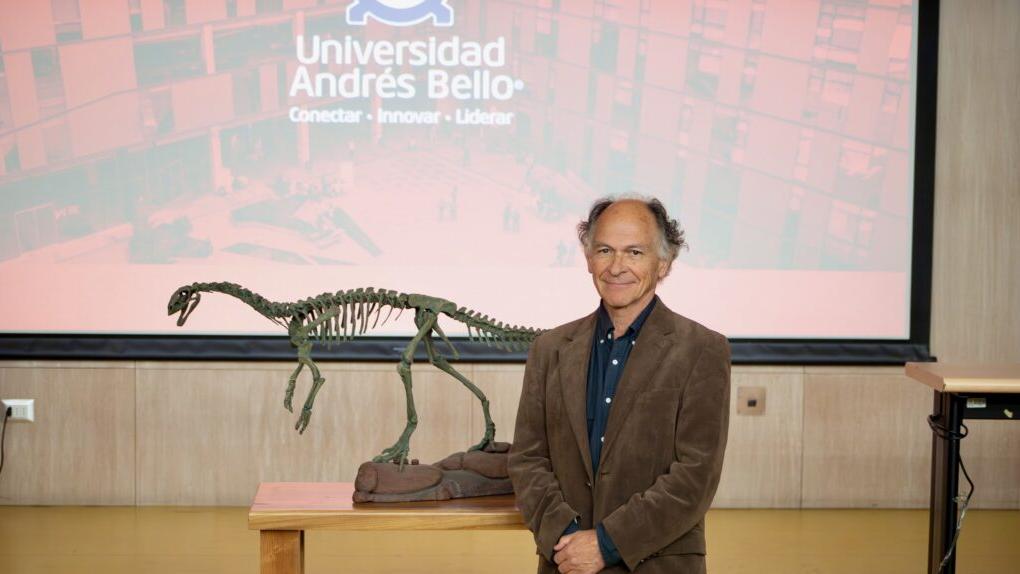
Over half a century dedicated to research and teaching mark the life of the academic and researcher from Universidad Andrés Bello, who has left an indelible mark on the geology and paleontology of our country, especially in the Aysén Region. This nomination represents a significant milestone, as this time a geologist is being proposed for this prestigious national recognition.
Chile has a wide range of landscapes that reflect millions of years of geological history from north to south. And in this context, Universidad Andrés Bello and the Regional Museum of Aysén have nominated geologist, academic, and researcher Dr. Manuel Suárez for the National Prize of Natural Sciences, due to his outstanding contribution to the country’s geology and paleontology through over fifty years of research and publications.
«Through his research, he has played a fundamental role in the understanding of the geology of our territory, laying solid foundations for the deepening and dissemination of knowledge. Likewise, his publications have had a direct effect on improving the quality of life in communities across various southern localities, by providing valuable information for mineral resource prospecting, water resource management, land-use planning, urban development, tourism growth, and the conservation of geological heritage,» said UNAB Rector Julio Castro when presenting the nomination.
For his part, the director of the Regional Museum of Aysén, Gustavo Saldivia, stated that “the work of geologist Manuel Suárez has had a significant impact in the Aysén Region. His work has contributed to the social, cultural, educational, and economic development of this area. The geological knowledge provided by Dr. Suárez has been essential for tourism and territorial planning in the region. His work has enabled a deeper understanding of natural resources and has enriched local identity.” For his nomination for the National Prize, the geologist received broad support from individuals and organizations who highlighted his commitment to his discipline and his contribution to the understanding of one of the southernmost areas of our country.
Most recent discoveries: Chilesaurus diegosaurezi and the grandfather of crocodiles
His paleontological discoveries have crossed borders, being one of the few Chilean scientists to discover ancient species from the Jurassic period. These discoveries have placed Chile on the world map and opened countless doors to research and understanding of our past.
Among the most renowned findings of the UNAB academic is the 2004 discovery of Chilesaurus diegosaurezi, a dinosaur from the Jurassic period. This prehistoric animal’s discovery is considered one of the most important in paleontology in recent decades. In fact, it was featured on the cover of the journal Nature and made headlines in international media.
For the Aysén community, where it was discovered, it had a very significant impact not only for tourism but also for regional identity, as schoolchildren in the area now call themselves “the children of the Chilesaurus.”
In the same area, Dr. Suárez led expeditions where fossil bones from three different sauropod lineages were found, including possible Titanosauriformes and Diplodocoidea, as well as the first unequivocal record of Diplocinae from the Late Jurassic of South America.
These findings add to others made in 2014 together with Argentine researchers in the same area where the Chilesaurus was discovered. On that occasion, fossils of a new species of terrestrial crocodile called Burkesuchus mallingrandensis, dated at 150 million years, were found. It is considered the “grandfather” of crocodiles due to its surprising features.
Many of the fossils discovered by Suárez during his expeditions, as well as replicas of the prehistoric animals he uncovered, are currently exhibited at the Regional Museum of Aysén and the Natural History Museum in Santiago.
Mapping Chile’s Geological Identity
Manuel Suárez is a geologist from the University of Chile and holds a PhD in Philosophy from the University of Birmingham, England. Throughout his academic and research career, he has published more than 100 papers in conferences, book chapters, and scientific journals, 60 of which are indexed in high-impact journals such as Nature, Earth and Planetary Science Letters, or Scientific Reports. He is also the author of Worlds of Cape Horn, chronicles of a geologist’s explorations and historical accounts, a book that recounts little-known events from his many scientific expeditions.
His participation as a member of the Geological Research Institute and FONDECYT, along with awards and scholarships from organizations such as the British Council, the Organization of American States, the United Nations Office for Disaster Relief, and the Royal Society, attest to his prestige and recognition in the scientific community.
Among geologists, Professor Suárez is known as a tireless expeditionary who has dedicated his life to research and fieldwork, participating from a young age in major scientific expeditions, particularly in the far south of the country, where he has explored remote, hard-to-access places of geopolitical importance to Chile.
From his explorations, he has published geological maps of both the north and southernmost parts of the country. These documents have been fundamental for regional development, as they have enabled, among other things, mining exploitation, water exploration, and territorial understanding to help prevent disasters such as earthquakes and landslides.
Among his most relevant contributions in this field is the impetus he gave to Chile’s geological cartography. In the second half of the 1970s, Suárez led the creation of new series of the Geological Map of Chile by the Geological Research Institute, now SERNAGEOMIN. His work sparked a wave of publications beginning in 1977, reflected in geological maps and articles in indexed journals and conferences. Additionally, he led the creation of the 1:1,000,000 scale Geological Map of Chile, which promoted scientific research and geological understanding.
Other aspects of his legacy include the use of plate tectonic concepts to explain the geological connection between the Andes and the Antarctic Peninsula, published in the journal Geology, and his research in the southernmost part of the country, including the Beagle Channel, Cape Horn, and Aysén.
Currently, Dr. Suárez is a professor at the Faculty of Engineering and the Geology program at Universidad Andrés Bello, an institution he has been part of for 13 years, where he has served as both a teacher and researcher, influencing the education of hundreds of students.