
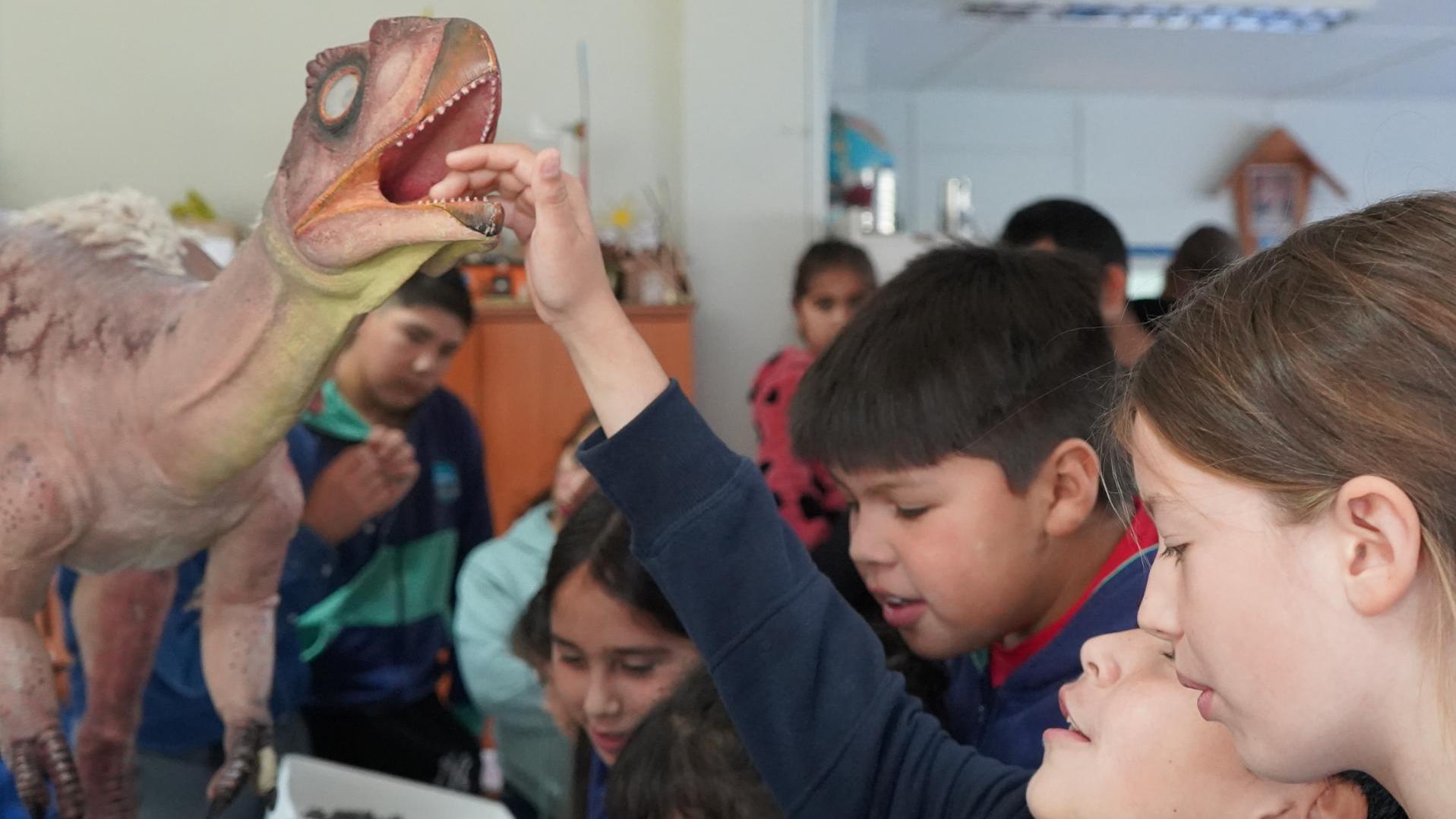
The project will run for 14 months, during which the foundations will be laid for what is expected to become the first geopark in the Aysén Region, leveraging the exceptional geological and paleontological richness of the General Carrera Province (Provincia General Carrera).
“We want a geopark in the Aysén Region!” This is the core message behind the Chelenko Geopark Project (Proyecto Geoparque Chelenko), led by the Aysén Regional Museum (Museo Regional de Aysén). Its goal is to highlight the valuable natural heritage of the General Carrera Province, an area with internationally significant geological diversity.
The project’s official launch took place on April 1 and 3 in the municipalities of Río Ibáñez and Chile Chico, marking the beginning of an ambitious process that, within four years, seeks UNESCO Global Geopark recognition.
According to Carolina Pérez Dattari, Undersecretary of Cultural Heritage, “This is a major step toward achieving a UNESCO-recognized geopark in the Aysén Region. First, because it brings the community closer to heritage education—allowing them to understand their environment and the history of our planet. Second, because it supports sustainable development, helping improve the lives of those living in Aysén. And finally, because it promotes scientific development—encouraging knowledge creation in the region. Here, we may find key pieces to understand the history of humanity and Earth.”
UNESCO Global Geoparks recognize not only geological and biological heritage, but also cultural heritage, actively involving local communities. For this reason, the participation of General Carrera Province residents will be essential in future stages of the project.
A Raw Heritage Treasure
This initiative, funded as a CORFO Public Good Project through the Regional Government of Aysén, aims to establish the region’s first geopark in General Carrera Province—an area with the highest number of recognized geosites in the country, according to the Geological Society of Chile (Sociedad Geológica de Chile).
Andrea Macías Palma, regional governor of Aysén, emphasized: “This project marks the starting point for a long-held dream—to have a UNESCO-recognized geopark in our region. We are deeply committed to heritage issues. As a regional government, we’ve been investing in this field for years, because we know that geological and paleontological knowledge allows us to give value to our territory. It also helps us build a development strategy that connects productive sectors with heritage, allowing nearby communities to grow.”
This region is home to one of the most extraordinary discoveries of the century: Chilesaurus diegosuarezi. Manuel Suárez Dittus, a geologist and member of the team that discovered it twenty years ago in Mallín Grande, explains that the General Carrera Lake Basin (Cuenca del Lago General Carrera)—the area targeted for geopark status—contains several geologically and paleontologically significant sites.
“What draws the most attention is the Chilesaurus fossil we found in 2004. It was studied and published in the journal Nature, even making the cover in 2015. It’s a very rare Late Jurassic dinosaur, so unusual that it shook up the paleontology field. Some of our team believe it’s the most unique dinosaur found in the past 100 years, because it combines features of both herbivores and carnivores,” says Suárez, who will give public talks throughout the project.
Geoheritage for Local Communities
A key focus of the project is its educational and community-centered approach. During its initial phase, the project aims to strengthen the connection between lakeside communities and the geological heritage of the General Carrera Lake (Lago General Carrera) area. Through educational activities and outreach, the Aysén Regional Museum hopes to share the stories of the Chilesaurus diegosuarezi, the Plesiosaur, and the Burkesuchus mallingrandensis (a prehistoric relative of South America’s freshwater crocodiles).
Gustavo Saldivia Pérez, director of the museum, explained:
“Our focus has been to ensure that the residents of the lake are the primary beneficiaries of the natural wonders within their own territory. This is about building local pride, creating real economic opportunities, and promoting the protection of their heritage. Additionally, this project lays the foundation for future inclusion of the General Carrera Lake region in the UNESCO Global Geoparks Network. While it will take years of work and community approval, this is our starting point.”
The project will be carried out over a 14-month period. During this time, the team will define the boundaries of the future geopark, conduct geological, biological, and cultural inventories, and develop a community-driven governance and management plan. These steps will set the foundation for what is expected to become the first geopark in the Aysén Region.